Have you ever found yourself jotting down things you’re grateful for, only to realize you’re just going through the motions? That was me. My daily prayers kept getting longer as I kept adding more and more to my gratitude list, making sure nothing was missed. But one day it hit me: I was reciting a list, not actually feeling any of it. The ritual had replaced the real emotion.
Todd Olson helped me understand why. He’s a trauma specialist, licensed clinical social worker, and somatic experiencing practitioner. Luke and I first spoke with him about gratitude a year ago, and this episode marks his third visit to the Mental Fitness Podcast.
It comes down to a line I said on the show: Gratitude you list is a thought, and that’s good. Gratitude you feel changes your body.
The Power and Limits of Gratitude Lists
Gratitude journals work. In a well-known experiment, psychologists Robert Emmons and Michael McCullough compared people who kept a weekly gratitude journal with people who wrote about hassles or neutral events. The gratitude group exercised more regularly, reported fewer physical symptoms, felt better about their lives as a whole and were more optimistic about the week ahead. I brought that study up in our conversation.
Todd agrees. He kept a gratitude journal himself until it started to feel like just another task. Once gratitude becomes something to check off your to-do list, it starts to lose its power.
His fix is simple: Spend two extra minutes with one thing you’re grateful for. Ask yourself: Why am I grateful for this? How do I know?
Turn Lists Into Feelings: The Two-Minute Shift
Todd tried it on us live. He asked Luke what had brought him joy lately. Luke started with his two kids, and Todd asked him to narrow it down to one moment from the past week.
Luke picked that same morning. His six-year-old had been explaining his world the way six-year-olds do, and Luke and his wife looked at each other and laughed. Then Todd asked how Luke knew it was joy, and he meant physically. Luke felt warmth in his chest and a smile that appeared without any effort.
When it was my turn, I said I was grateful for my mom. Todd asked why. I gave him a tidy answer: going through hard times with my own teenagers and young adults has made me appreciate my parents more. He pointed out that I was still skirting it, so I slowed down.
What came up was her tenderness when I was growing up, and the love I still feel every time I talk to her. I had to fight back tears to get the words out. In my body, it was a burning, joyful feeling right in the middle of my chest.
Todd’s point: A journal entry might just say “grateful for Mom” and move on. But spending those extra two minutes, asking why, lets it sink in. Both of us felt the difference.
He also noted that hard feelings are easier to find in the body. Heaviness and the urge to lie down are hard to miss. Joy and gratitude take longer to notice, and they often show up as a sense of openness, or sitting a little more upright.
Can You Train Yourself to Truly Feel Gratitude?
Luke asked if someone who’s never felt gratitude in this way can learn it. Todd’s answer: absolutely. Some people grow up with it, but the rest of us can train it. He links it to empathy: if empathy is hard, feeling gratitude will be too, but both get easier with practice.
It starts with tuning in to your body. Feel your feet on the ground and the chair supporting you. If you catch yourself hovering, try this: Raise your shoulders to your ears and press your tongue hard against the roof of your mouth. Hold, then release both at once. Most people settle a little deeper into their seat. Todd says small resets like this help you reconnect with yourself.
When Gratitude Feels Impossible: What to Do
Some years are hard. Luke asked what happens when someone can’t get to gratitude at all. Todd said a nervous system stuck in fight-or-flight or shutdown will struggle with it. He also named a mistake the rest of us make when someone is hurting. We cheerlead: “Come on, get happier. Think positive.”
Todd pointed us to Susan Cain’s book, Bittersweet: How Sorrow and Longing Make Us Whole. The main idea: When we make space for sadness and longing, we can experience more love, gratitude, and joy. Sorrow and appreciation can live side by side.
He sees this in his office. When clients apologize for being sad, he tells them they should be sad. Allowing sadness gives us permission to be human, and as he put it, sadness and longing help us recognize what matters.
He gave a few examples of how that sounds out loud:
- “I miss my friend deeply and remembering our laughter brings me joy.”
- “I am sad that this season of life is ending and I’m grateful that I’ve lived it.”
My wife has her own version, which she says when something good comes to an end: “Don’t be sad that it’s over. Be grateful that it happened.”
This hit home for me. My father has passed away, and my older kids have moved out. We’re still close, but it’s never quite the same, so I savor the time with my younger ones more. Appreciate the people you have while you have them.
Coping With Loss and Loneliness During the Holidays
I asked Todd what someone dreading the holidays should do, whether it’s an empty chair or a hard family. His first answer was to let the sorrow and longing in, and not to let anyone cheerlead you out of them. Then think back to a past moment of gratitude. And do something about it.
If you’ve lost someone, go do something they loved to do, and let yourself be sad while you do it. If you have nowhere to be, Todd suggested volunteering, like serving at a soup kitchen. Some of the people in line may be lonely too, and connecting with them can shift something in you.
If the loneliness continues, Todd recommends reaching out for professional support, and reminds us there’s no shame in it.
The Gratitude Letter Challenge: Read It Face-to-Face
Todd left us with the same challenge as before: Pick someone you’re grateful for and write them a 250–300 word letter explaining why. Arrange to meet without telling them why, then read it to them face-to-face. If you can’t be together, do it over video. Todd believes the person reading the letter out loud benefits even more than the one hearing it.
Research suggests most of us expect it to go worse than it does. In three experiments, psychologists Amit Kumar and Nicholas Epley had people write gratitude letters and predict how the recipients would feel. The writers underestimated how surprised and happy the recipients would be, and overestimated how awkward they’d feel.
Todd suggested I write mine to my mom. He also told me I wouldn’t make it through without crying, and he’s probably right. He recommends a letter like this at least twice a year, and he keeps blank cards in his office for shorter notes in between.
A New Thanksgiving Tradition: The One-Word Round
Going around the table to share what you’re thankful for can feel cheesy and take forever. Todd’s version: Before the meal, everyone says just one word about what they’re grateful for or what’s brought them joy.
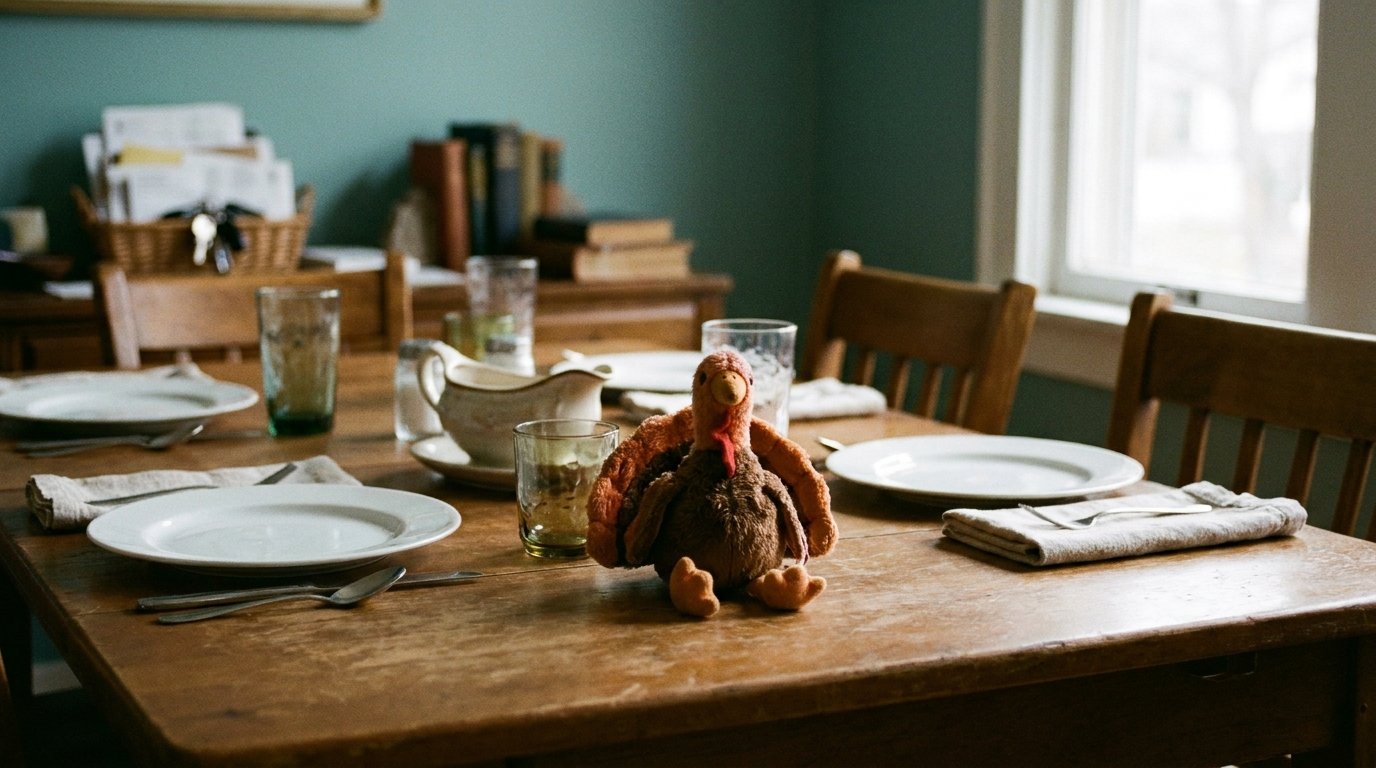
Ask someone who will do it well to go first. Nobody talks except the person sharing. Todd likes a small stuffed turkey that gets tossed to whoever goes next, and the little kids can’t wait to grab it. One rule from our first conversation: you can’t repeat a word someone else already used. It makes everyone think harder.
Finding one word is harder than it sounds, which slows everyone down. My word would be grandma, since most of the table would be her grandkids. Todd’s would be love. When everyone’s done, he likes to name the quiet in the room before the meal gets noisy. That stillness is connection.
This Week’s Gratitude Experiments
- Pick one specific moment from the past week and ask yourself why you’re grateful for it. Spend two more minutes reflecting than you normally would.
- Feel it in your body. Ask yourself, “How do I know I’m grateful?” Look for signs, like a sense of warmth in your chest or an unexpected openness.
- Settle first if you need to. Lift your shoulders to your ears and press your tongue to the roof of your mouth, then drop both and notice the chair holding you.
- Say the hard part and the good part together. Try a sentence like I miss ___, and I’m grateful for ___.
- Write one letter. Write 250 to 300 words to someone you’re grateful for, then read it to them where you can see each other’s faces.
- Bring one word to the table. At your next family meal, ask everyone for a single word, with no repeats.
Todd shared a line that sticks with me: “I cannot keep this moment forever, and I am thankful to be here for it.” That’s the whole practice: truly saying it, and meaning it.